seventh crystal heaven
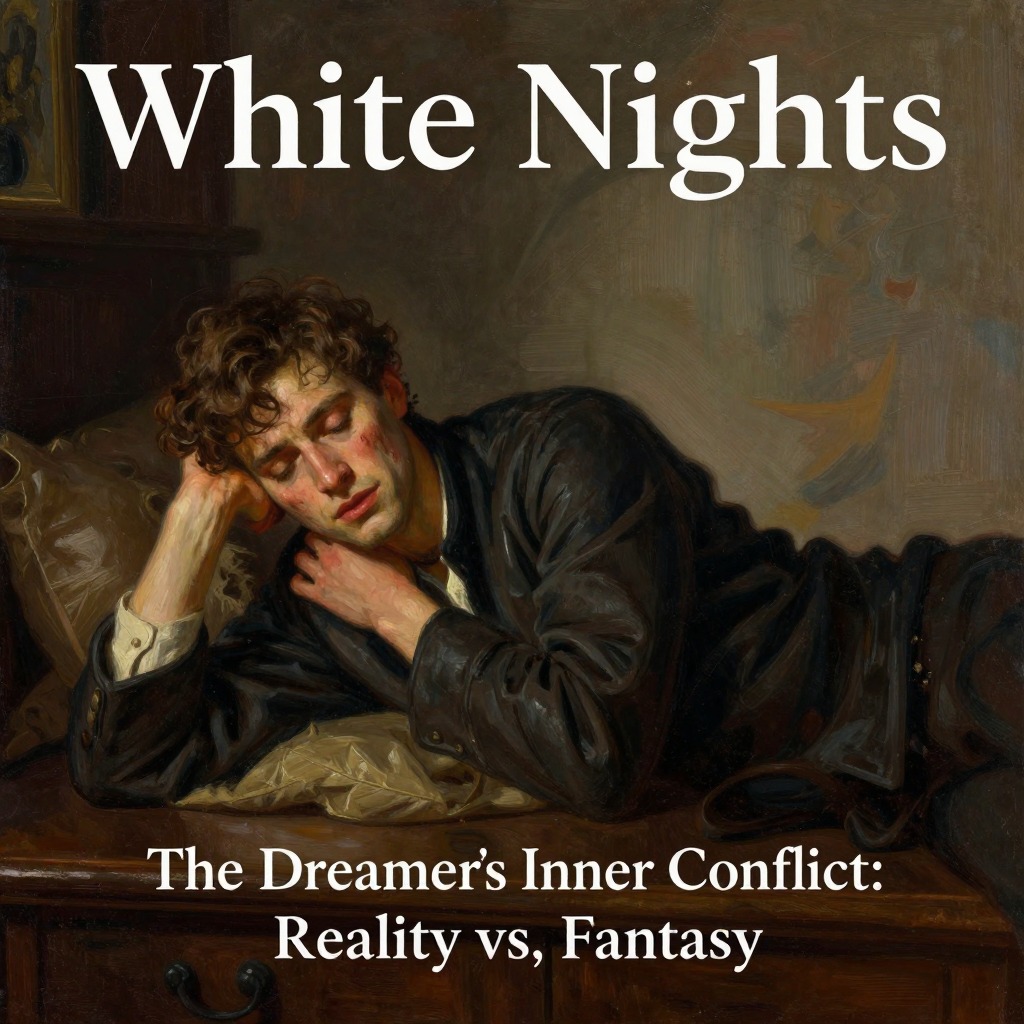
The seventh crystal heaven is a metaphorical expression that appears in the Dreamer's extended monologue during the Second Night of Fyodor Dostoevsky's "White Nights." It crystallizes the central tension of his existence: the intoxicating power of fantasy versus the crushing weight of reality. The phrase is not merely a decorative flourish but a precise index of the dreamer's psychological state, marking the moment when imaginative escape reaches its most extreme and self-deceptive peak.
Origin and Context
The expression emerges in the Dreamer's elaborate self-portrait, delivered to Nastenka as he attempts to define what it means to be a "type" — an original, an absurd person, a dreamer. He describes the daily ritual of his imaginative life: after his work is done, as the evening glow fades over the cold Petersburg sky, he walks the streets while "the Goddess of Fancy" begins to spin her golden warp. It is at this point, he tells Nastenka, that her "fantastic hand has borne him to the seventh crystal heaven far from the excellent granite pavement on which he was walking his way." The phrase thus enters the narrative as the climax of a carefully built sequence: the dreamer, released from the irksome duties of the day, becomes rich with his own individual life, and the fading sunset sheds its farewell gleams before him, calling forth a swarm of impressions from his warmed heart. The seventh crystal heaven is the destination of this flight — a realm so elevated that the ordinary world, with its granite pavements and respectable old ladies asking for directions, becomes utterly invisible.
Meaning and Function
The seventh crystal heaven operates as a metaphor for the ultimate height of imaginative transcendence. It draws on the traditional cosmological image of seven heavens, a structure found in various religious and mystical traditions, where the seventh is the highest, the dwelling place of the divine. By adding "crystal," the Dreamer emphasizes the purity, fragility, and artificial brilliance of this realm — it is a constructed space, transparent and beautiful but also brittle and cold. The phrase captures the dreamer's complete absorption in his own fantasies: he is not merely daydreaming but has been transported to a different ontological plane. The evidence shows that when he is in this state, he cannot remember where he is standing or through what streets he is going; he starts and almost cries out when a respectable old lady stops him politely to ask her way. The seventh crystal heaven is thus the name for that condition of radical disconnection from the sensory world, a state where the dreamer's inner life has entirely supplanted external reality.
Contrast with Reality
The power of the expression lies in its sharp juxtaposition with the mundane details that surround it. The Dreamer's monologue is filled with the concrete textures of Petersburg life — the granite pavement, the old lady, the laughing child, the peasants spending their nights in barges on the Fontanka. The seventh crystal heaven is the anti-world to all of this, a space of pure fantasy where none of these ordinary irritations can reach him. Yet the narrative structure of the monologue itself undercuts this escape. The Dreamer describes how, after the flight of fancy, he returns to his comfortable den, and "the whole kingdom of fancies drops to pieces about him, drops to pieces without a trace, without a sound, floats away like a dream." The seventh crystal heaven is thus revealed as a temporary, unsustainable state. The very vividness of its description — the golden warp, the fantastic hand, the seventh crystal heaven — makes its inevitable collapse more poignant. The dreamer is left with a vague sensation that faintly stirs his heart and sets it aching, and a swarm of fresh phantoms must be summoned to fill the void.
Thematic Significance
The seventh crystal heaven is a key term in Dostoevsky's exploration of the dreamer's psychology. It represents the seductive but ultimately sterile nature of a life lived entirely in imagination. The Dreamer himself acknowledges this when he tells Nastenka that he has lost all his best years, and that his life is a crime and a sin. The seventh crystal heaven is the name for the false paradise that has cost him real life. The phrase also carries a subtle irony: the "crystal" suggests something that can shatter, and the narrative bears this out. When the Dreamer's real encounter with Nastenka begins to offer the possibility of actual love, the seventh crystal heaven is implicitly abandoned. The real world, with all its pain and uncertainty, proves more compelling than the most elaborate fantasy. Yet the expression lingers as a haunting image of what the dreamer must give up — the perfect, controlled, self-created world of imagination — in order to enter the messy, unpredictable realm of genuine human connection. The seventh crystal heaven is thus both a prison and a paradise, and the Dreamer's tragedy is that he can never fully inhabit either.